Many therapists in Oregon already post on Instagram, some well, most rarely. This lesson is the version I would hand a colleague: how to set up a professional account and connect it to a Facebook Page using Meta's own instructions, what a practice can post without a client story, where the ethics rules bite in practice, and a cadence a solo clinician can keep for a year. Meta's steps are linked so you can follow the current version; the ethics quotes are from the ACA code and Oregon's board rules.
1. Switch to a professional account
Instagram's Help Center page says: "Business accounts are best for retailers, local businesses, brands, organizations and service providers." A practice is a service provider; choose Business. The steps from the app, as the page lists them: tap More to open Settings and activity, then under For professionals tap Account type and tools, then Switch to professional account. Two lines on the page matter for a therapist: "If your personal account is private, switching to a professional account will make it public. All pending follow requests will be automatically accepted when you go public." Do this on a fresh practice account, not on the personal account where your family posts. The switch is free, and the page says "you can switch back to a personal account, or change your professional account type anytime."
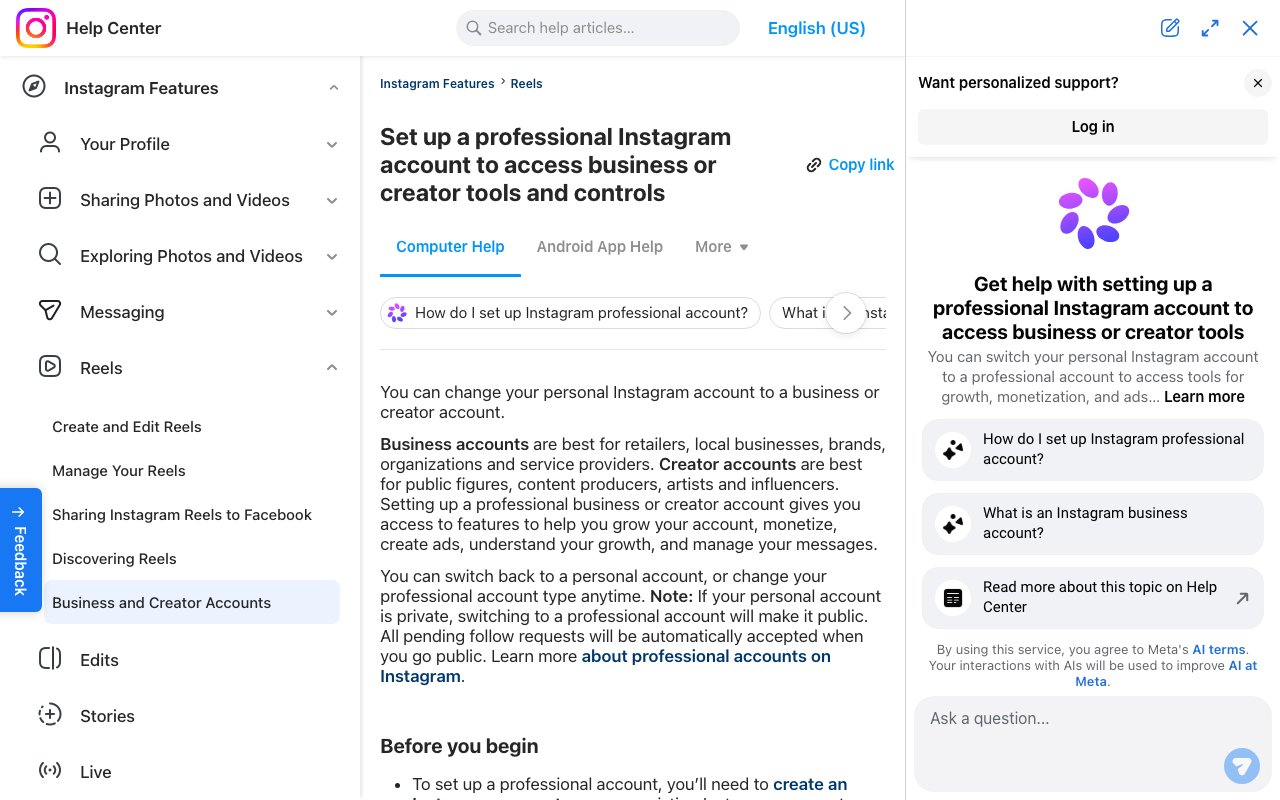
Screenshot to add: [the Account type and tools screen in the Instagram app, with Switch to professional account visible]
2. Create a Facebook Page and connect it
Meta's connection page says you need "a professional Instagram account" and "full control of a Facebook Page" before you can link them, and that a personal account is prompted to switch during linking. Two consequences it spells out: "anyone with access to either the Page or your Instagram account will be able to manage both assets," and once linked "you won't be able to share to another Facebook Page or to a Facebook profile." So make the Page a practice Page, give access only to people who should have it, and expect posts to cross-post there and nowhere else. The connected pair is what Meta's business tools manage, and what any paid ad later runs from.
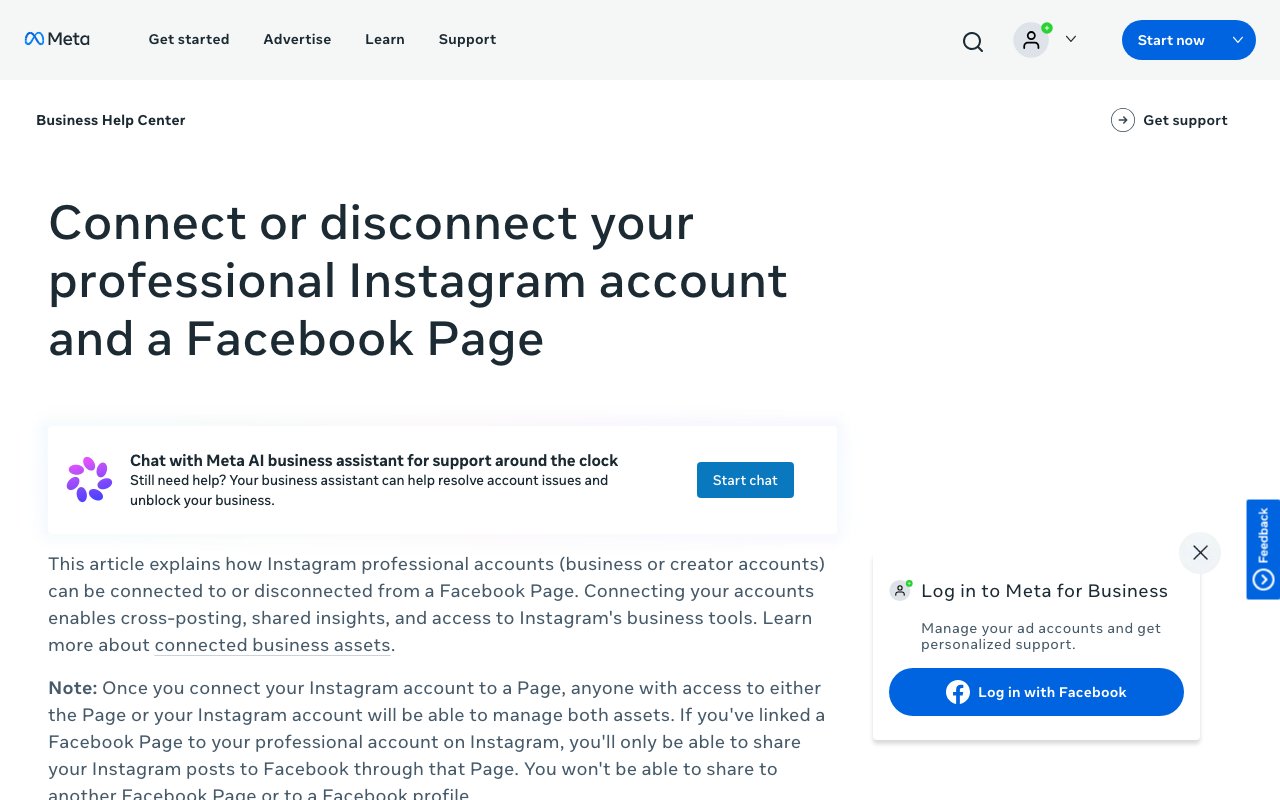
Screenshot to add: [the Instagram Edit profile screen showing the connected Page row]
3. Write a bio the board would sign
The bio is an advertisement. The ACA Code of Ethics, C.3.a: counselors "identify their credentials in an accurate manner that is not false, misleading, deceptive, or fraudulent." Oregon's OAR 833-050-0111(1)(a) requires a registered associate to carry the associate title on advertising, never an abbreviation that implies licensure, plus the supervisor's name and the word supervisor. Name, credential exactly as issued, city, who you work with, how to book. Nothing else needs to be there.
4. What to post when you cannot post about clients
My rule for this directory's own account is service framing, never condition framing. "Find a therapist for anxiety in Eugene" describes a service. "Five signs you have depression" makes a claim about the reader and invites the wrong replies. The logic Meta applies to ads under its Personal Attributes standard, no asserting or implying someone's mental health, is a good habit in organic posts too, though the standard itself governs ads. What that leaves is plenty:
- The office, the waiting room, the parking, the walk from the bus stop.
- What a first session looks like, minute by minute, with no client in it.
- Fees, sliding scale, which insurance you take, and what a superbill is.
- What you do not treat and who you refer to instead.
- Hours changing, a new group opening, a waitlist closing.
- Your own continuing education, in one sentence, with what it changes for clients.
Every slide of a carousel should stand on its own, because a slide can be seen without its caption. On Reels versus carousels: I looked for a statement from Instagram or Meta in the last twelve months saying which performs better and found none; every number in circulation is a third-party estimate. Post the format you can make well.
5. The ethics line in practice
Testimonials. ACA C.3.b: "Counselors who use testimonials do not solicit them from current clients, former clients, or any other persons who may be vulnerable to undue influence. Counselors discuss with clients the implications of and obtain permission for the use of any testimonial." Oregon's OAR 833-100-0012(3): "Testimonials from current clients are not solicited for advertising or other purposes due to the client's vulnerability to undue influence." So: never ask a client for a post, a tag or a review. If one arrives, do not repost it without the permission conversation the ACA describes, and consider not reposting it at all.
Comments and messages. A public reply that confirms someone is a client discloses a clinical relationship. My standing rule: answer comments with general information, never with anything that confirms or denies that the commenter is or was a client, and move anything personal to the phone. A saved reply for direct messages ("Thank you for reaching out. For anything about care, please call the office.") keeps the account from turning into an intake form. I could not find an HHS page that addresses Instagram comments or messages specifically, so treat this as my conservative reading, not a regulator's statement.
Screenshot to add: [a saved reply in Instagram's message settings]
6. A cadence you can keep
Here is the cadence I would give a solo practice, and it is deliberately light:
- One feed post a week, made in a monthly batch of four on one afternoon.
- Stories only when something happened: a new group, a schedule change, a photo of the office in October.
- Five hashtags at most per post. I stopped at five for this directory's account and have not missed the rest.
- Comments and messages checked once a day, at a set time, with the saved reply ready.
- A look at the bio and the Page connection every quarter, since credentials, hours and supervisors change.
That is 52 posts a year and perhaps twenty hours of work. If it brings one client who would not otherwise have found you, it has paid for itself; if it brings none, you will know by month six and can stop without guilt. Paid ads, and the rules that govern them, are in Meta ads and the rules for therapists. The attached checklist covers the setup and ethics steps.
Sources
- “Set up a professional Instagram account to access business or creator tools and controls.” Instagram Help Center. Steps, public-account consequence, reversible switch. https://help.instagram.com/502981923235522 (accessed Sep 24, 2026).
- “Connect or disconnect your professional Instagram account and a Facebook Page.” Meta Business Help Center. Requires full control of a Page; shared access consequence. https://www.facebook.com/business/help/connect-instagram-to-page (accessed Sep 24, 2026).
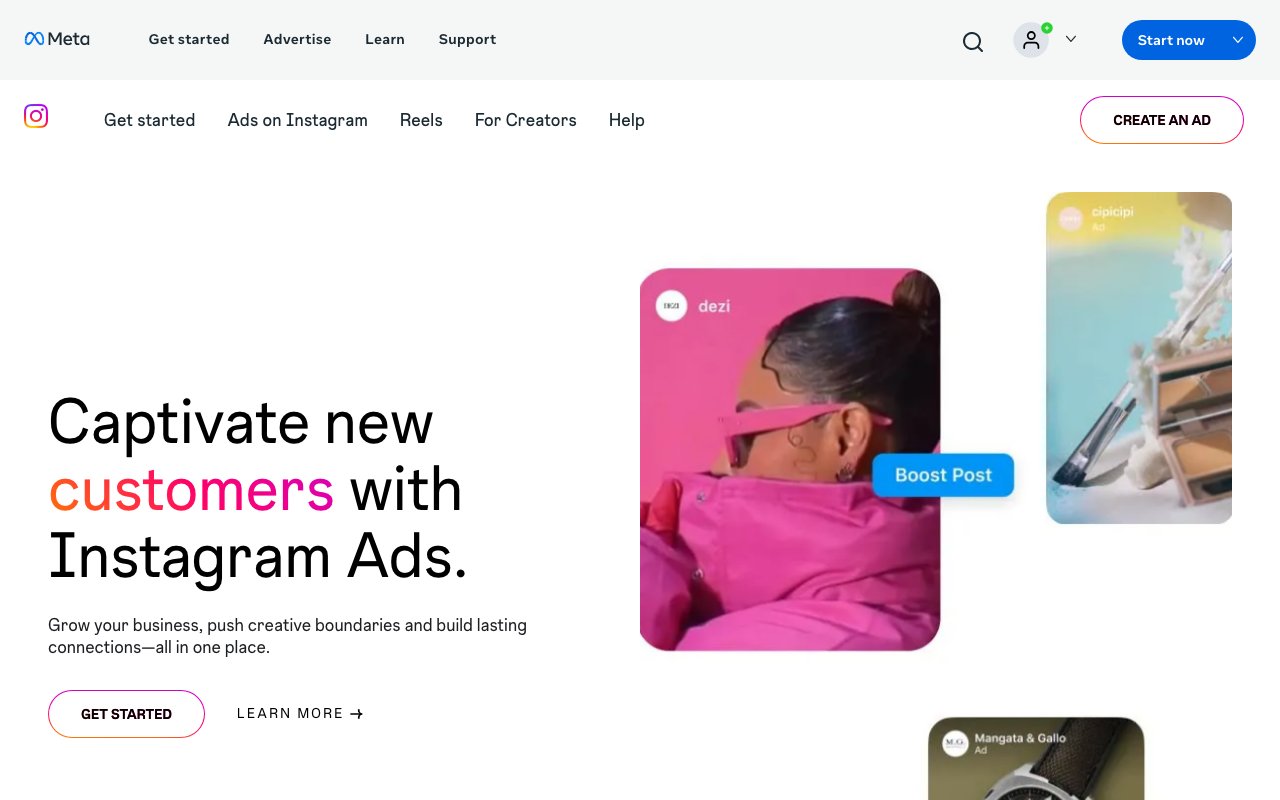
- “Instagram for Business: Marketing on Instagram.” Instagram for Business. Landing page reached from the Meta Business Suite URL. https://business.instagram.com/meta-business-suite (accessed Sep 24, 2026).
- “Privacy Violations and Personal Attributes.” Meta Transparency Center, Jun 26, 2024. Ad standard cited as a habit for organic posts. https://transparency.meta.com/policies/ad-standards/objectionable-content/privacy-violations-personal-attributes/ (accessed Sep 24, 2026).
- “2014 ACA Code of Ethics.” American Counseling Association. Sections C.3.a and C.3.b quoted. https://www.counseling.org/docs/default-source/default-document-library/ethics/2014-aca-code-of-ethics.pdf (accessed Sep 24, 2026).
- “Statutes and Oregon Administrative Rules (ORS 675, OAR chapter 833).” Oregon Board of Licensed Professional Counselors and Therapists. OAR 833-100-0012(3) and 833-050-0111(1)(a) quoted. https://www.oregon.gov/oblpct/Documents/BLPCT_Statutes-OARs.pdf (accessed Sep 24, 2026).
Documents
Templates and worksheets that go with this lesson.
Instagram setup and ethics checklist