This lesson covers the superbill: what it is, what goes on it, the handful of CPT and place of service codes an outpatient therapist uses, and the Good Faith Estimate the No Surprises Act requires for self-pay clients. I wrote it for grad students and new Oregon clinicians who are out-of-network with most plans, or with all of them, and who want to hand a client a document their insurer will accept. The codes come out of the chart, which the progress notes lesson covers.
A superbill is a receipt, not a claim
A claim is what a provider, usually a contracted one, sends to a plan. A superbill is what an out-of-network provider hands the client: an itemized receipt with the codes on it, which the client submits to their own plan for whatever out-of-network reimbursement that plan offers. The money moves in that order. The client pays you, the client files, and the plan pays the client, applies the charge to a deductible, or declines. Nothing about the superbill obligates the plan.
No federal rule defines the term; as far as I can find, neither CMS nor the National Uniform Claim Committee treats "superbill" as a term of art. The field list below is what vendors such as SimplePractice converge on because it mirrors a plan's own claim form. That is industry practice; no statute sets it.
What goes on it
- You: practice name, address and phone; your name and degree; license number; National Provider Identifier (NPI); and Tax ID, which is an EIN or, for some solo practices, a Social Security number.
- The client: name exactly as the plan lists it, and date of birth.
- Each session: date of service, CPT code, place of service code, the diagnosis code, and the fee charged. The federal Good Faith Estimate rule defines a diagnosis code as one from the ICD code set and a service code as CPT or HCPCS, and that is what plans expect on a superbill too.
- A signature, or a "signature on file" line, and a total for the period.
Before the first one leaves the office, confirm the NPI and Tax ID are correct and that the client's name matches their card. The superbill template attached to this lesson has all of these fields laid out.
The four codes you will use most
CPT codes belong to the American Medical Association and the full descriptors are licensed text, so what follows is a paraphrase. Your EHR's built-in code list carries the current wording.
- 90791: the psychiatric diagnostic evaluation, meaning the intake, without medical services.
- 90834: individual psychotherapy, the roughly 45-minute code.
- 90837: individual psychotherapy, the roughly 60-minute code. The AMA's public page for 90837 gives only a short title and a sample patient.
- 90847: family or couples psychotherapy with the client present.
There is also 90832 for a roughly 30-minute session. The times are approximate on purpose: the exact thresholds live in the CPT book, and a payer can have its own policy on which code it accepts for a given length. Check with the payer.
Place of service: 11, 10 or 02
Place of service (POS) codes are a CMS code set. POS 11 is Office. POS 10 is telehealth provided in the patient's home. POS 02 is telehealth provided somewhere other than the patient's home. Some payers also ask for a modifier on telehealth sessions, such as 95; that is payer policy rather than a CMS rule, so check the payer's telehealth billing policy. The telehealth lesson covers the Oregon rules for the session itself.
The CMS-1500, briefly
The CMS-1500 is the paper claim form for non-institutional providers, maintained by the National Uniform Claim Committee, not CMS. CMS's own page on the form says paper 1500s go to Medicare only under an electronic-filing waiver, and must be the pre-printed red-ink version because photocopies fail scanning. If you are out-of-network and your client is the one filing, you do not need it; the superbill carries the same information.
Oregon's balance billing law, and where it stops
Oregon's balance billing statute, ORS 743B.287, bars an out-of-network provider from billing a member of a state-regulated plan for emergency services, and for other services delivered at an in-network facility. Subsection (3)(b) carves out non-emergency services to an enrollee who chooses an out-of-network provider, which is the out-of-network therapist in their own office, and the superbill model, where the client pays the full fee and seeks reimbursement, is the ordinary arrangement. Subsection (5) attaches a duty to the client's choice: the provider "shall inform the enrollee that the enrollee will be financially responsible" for the coinsurance, copayments and other out-of-pocket costs of going out of network. Many practices put that notice in their intake paperwork. Ask an attorney if a client's plan says otherwise.
The Good Faith Estimate for self-pay clients
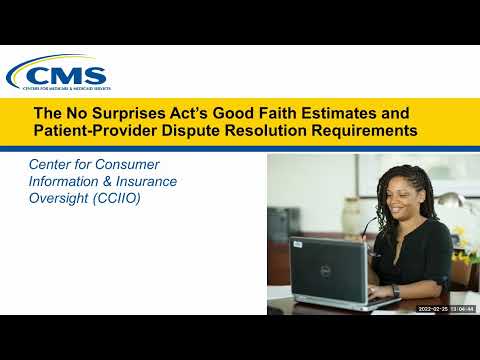
Since January 1, 2022, the No Surprises Act has required a written Good Faith Estimate (GFE) for uninsured and self-pay clients. The rule is 45 CFR 149.610. "Self-pay" includes an insured client who does not want a claim submitted, which describes many out-of-network therapy clients. The CMS video above walks through both the estimate and the dispute process.
Who counts, and when to ask
For each new client, the rule asks you to determine whether they have coverage and whether they want a claim submitted, and to tell self-pay clients an estimate is available: on your website, in your office, and orally when scheduling or whenever cost comes up. Any discussion of cost counts as a request.
The clock
- Session scheduled at least 3 business days out: deliver the GFE no later than 1 business day after scheduling.
- Session scheduled at least 10 business days out: no later than 3 business days after scheduling.
- Requested without a scheduled date: no later than 3 business days after the request, then a fresh one on the scheduling clock once the client books.
- If the scope changes (fee, frequency, provider), a new estimate is due at least 1 business day before the next session.
What it must contain
Section (c) of 149.610 lists it: the client's name and date of birth; a plain-language description of the primary service and its date if scheduled; an itemized list of expected services grouped by provider; applicable diagnosis codes, expected service codes and expected charges for each; your name, NPI, Tax ID, and the state and office location where you will see them; and a set of disclaimers. The disclaimers say that other services may be recommended and scheduled separately, that the estimate is only an estimate, that the client may use the patient-provider dispute resolution process if the actual bill is "substantially in excess" of the estimate and that doing so will not affect their care, and that the GFE "is not a contract".
CMS's plain-language fact sheet puts a number on "substantially in excess": $400 or more above the estimate. The estimate is part of the client's record and is kept like the rest of it, and a client can ask for a copy of any GFE you issued in the last six years. It must be written, on paper or in a format the client can save and print; telling them orally does not satisfy the rule on its own.
Weekly therapy on one estimate
Therapy recurs, and the rule allows one GFE for recurring services as long as it states the expected scope (timeframe, frequency, total number of sessions) and covers no more than 12 months. Past 12 months, or when the scope changes, a new one is due with a note on what changed. The GFE template attached to this lesson follows that structure. The rule says "applicable" diagnosis codes; before an intake you may not have one, and that question belongs to CMS's guidance, not to me.
When a client says the plan will not reimburse
The superbill does not create a benefit. What the client gets back depends on their plan's out-of-network terms: whether there is an out-of-network benefit at all, the deductible, and the allowed amount. Better the client asks those three questions before the first session than after six. When a superbill comes back rejected, compare the client's name, the NPI and Tax ID, and the code format against what the plan asked for, and check with the payer.
This is how I read the rules as a solo Oregon LPC, with the primary sources listed below; it is not legal or billing advice, and the payer, CMS, or an attorney gets the final word on your situation.
Real example from my own filing
The document attached below is rebuilt from my own EFT and ERA enrollments, redacted: the Availity form that covers most commercial plans and the vendor form Trillium routes through. Notice that both want the bank numbers typed in and a voided check attached, and that the remittance goes to the clearinghouse first and then into the EHR, which is what lets claims post without retyping. This is the one form where a typo moves money to the wrong account; check the routing number against the check twice.
Further reading
- CMS: No Surprises Act rules and fact sheets. The hub CMS keeps current, and the place to look when a GFE question goes beyond this lesson.
- SimplePractice: Superbills for therapy. A vendor's field-by-field walk through what makes a superbill usable by a client's plan; practical, not authoritative.
Sources
- “45 CFR 149.610, Requirements for provision of good faith estimates of expected charges for uninsured (or self-pay) individuals.” eCFR, Sep 23, 2026. Current eCFR text (up to date as of 2026-09-23); section added by 86 FR 56134 (2021-10-07), no substantive amendment since. https://www.ecfr.gov/current/title-45/subtitle-A/subchapter-B/part-149/subpart-G/section-149.610 (accessed Sep 24, 2026).
- “45 CFR 149.620, Requirements for the patient-provider dispute resolution process.” eCFR, Sep 23, 2026. Current eCFR text (up to date as of 2026-09-23); 149.620(a)(2)(ii) defines "substantially in excess" as at least $400 over the estimate. Section added 2021-10-07. https://www.ecfr.gov/current/title-45/subtitle-A/subchapter-B/part-149/subpart-G/section-149.620 (accessed Sep 24, 2026).
- “What's a Good Faith Estimate?.” CMS.gov, Jun 24, 2022. Fact sheet PDF dated 2022-06-24 (file metadata and server Last-Modified). The $400 figure it cites is in current rule text at 45 CFR 149.620. https://www.cms.gov/files/document/nosurpriseactfactsheet-whats-good-faith-estimate508c.pdf (accessed Sep 24, 2026).
- “Overview of rules and fact sheets (No Surprises Act).” CMS.gov, Aug 26, 2026. Page Last Modified date shown on the page; this URL now redirects to the CMS No Surprises billing section. https://www.cms.gov/nosurprises/policies-and-resources/overview-of-rules-fact-sheets (accessed Sep 24, 2026).
- “Place of Service Code Set.” CMS.gov, Feb 17, 2026. Page Last Modified date shown on the page; defines POS 02, 10 and 11. https://www.cms.gov/medicare/coding-billing/place-of-service-codes/code-sets (accessed Sep 24, 2026).
- “List of Telehealth Services (CY 2026 final list).” CMS.gov, Mar 4, 2026. Page Last Modified date shown on the page; the CY 2026 list carries CMS short descriptors for 90791, 90832, 90834, 90837 and 90847. https://www.cms.gov/medicare/coverage/telehealth/list-services (accessed Sep 24, 2026).
- “CPT code 90837: Psychotherapy, 1.” American Medical Association. No date on page; checked 2026-09-24. Page metadata gives first publication 2022-01-07. The AMA owns the CPT code set; full descriptors are licensed. https://www.ama-assn.org/practice-management/cpt/cpt-code-90837-psychotherapy-1 (accessed Sep 24, 2026).
- “Form CMS-1500.” CMS.gov, Sep 10, 2024. Page Last Modified date shown on the page (2024-09-10); checked 2026-09-24. https://www.cms.gov/medicare/billing/electronicbillingeditrans/1500 (accessed Sep 24, 2026).
- “1500 Instructions.” National Uniform Claim Committee, Jul 1, 2025. Page states the current 1500 instructions (v12.0) were released July 2025; page metadata modified 2025-07-01. Checked 2026-09-24. https://nucc.org/index.php/1500-claim-form-mainmenu-35/1500-instructions-mainmenu-42 (accessed Sep 24, 2026).
- “ORS 743B.287, Balance billing prohibited for health care facility services.” Oregon State Legislature. Official ORS 2025 Edition text; no date on page; checked 2026-09-24. Section last amended 2022 (2022 c.72 §1); (3)(b) and (5) as quoted. https://www.oregonlegislature.gov/bills_laws/ors/ors743B.html (accessed Sep 24, 2026).
Documents
Templates and worksheets that go with this lesson.
Superbill template (DOCX)
Good Faith Estimate template (DOCX)
Real example: EFT and ERA enrollment forms (PDF)