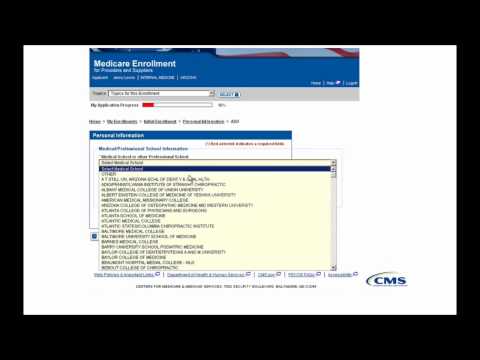
This lesson is the paperwork sequence for getting credentialed as an Oregon clinician: the NPI and taxonomy code, the CAQH profile (the CAQH Provider Data Portal; CAQH itself now does business as DataSpring), Oregon's uniform credentialing application, Medicare enrollment for LPCs and LMFTs, and Oregon Health Plan enrollment. I wrote it for new LPCs, LMFTs, LCSWs, and associates about to apply to their first payer, and I checked it against my own credentialing file, which now spans two years of forms. If the vocabulary is still fuzzy, read the previous lesson first. The video on this page is CMS's own walkthrough of a Medicare enrollment in PECOS. Sources are listed at the end with the date I read each one.
The order I would do it in
- Get your NPI and choose a taxonomy code.
- Check your license in the board's public search.
- Build and attest your CAQH profile.
- Fill out the Oregon Practitioner Credentialing Application once; keep a clean master copy.
- Enroll in Medicare through PECOS, if you will bill it.
- Enroll in OHP through the Oregon Health Authority, if you will bill it.
- Send each payer its packet and start the clock.
Step 1: the NPI and the taxonomy code
The National Provider Identifier is the ten-digit number on every claim. CMS's NPI fact sheet (December 2024) describes two types. Type 1 is for individuals, including sole proprietors, and a person can hold only one. Type 2 is for organizations; a clinician who has formed an LLC or corporation can hold a Type 1 for themselves and a Type 2 for the entity. The fact sheet is also blunt about what the number does not do: it does not show you are licensed or credentialed, does not guarantee payment, and does not enroll you with any plan.
CMS's How to Apply page lists three routes: online at NPPES, which CMS calls the fastest; a paper form; or an employer applying for you in bulk. Neither CMS page mentions a fee and I found none, so I will say there is no fee to apply rather than quote CMS on it. Neither page gives a turnaround time; the figures online come from third parties, so treat the wait as "varies."
The application asks for a taxonomy code. The National Uniform Claim Committee, which publishes the code set, explains that taxonomy codes describe your specialty, not the services you render. These rows from the current NUCC code file fit Oregon's master's-level licenses:
| License | Code | NUCC name |
|---|---|---|
| LPC | 101YP2500X | Counselor, Professional |
| LPC (alternative) | 101YM0800X | Counselor, Mental Health |
| LMFT | 106H00000X | Marriage & Family Therapist |
| LCSW | 1041C0700X | Social Worker, Clinical |
On the two LPC rows: CMS's Medicare FAQ (Step 5) names 101YM0800X as the Mental Health Counselor code for Medicare, and it is the code on my own NPI. If your NPI carries only 101YP2500X and you plan to enroll in Medicare, ask your Medicare contractor first whether to add the MHC code; the CMS documents I read do not address that combination. The taxonomy also has to match what you bill. PacificSource's Medicaid enrollment FAQ (August 2024) tells providers to check the code in the NPI Registry before filing an Oregon Medicaid application, because a code that does not match the services billed "will cause claim errors," and OHA's own application asks for the same code.
Step 2: your license, as the payer will see it
Payers verify licenses at the primary source. For Oregon counselors and MFTs that is the Board of Licensed Professional Counselors and Therapists, which points verifiers to its own License Search. Search yourself before you apply anywhere; if the name, number, or status differs from what you put on an application, expect the file to stall. The printout I keep in my packet is the board's own search result page, dated the day I ran it, which is what the redacted example attached to this lesson shows. Social workers verify through their own board, which I did not check for this lesson.
Step 3: the CAQH profile, the CAQH Provider Data Portal
Most commercial payers pull your documents from a shared profile that clinicians still call CAQH ProView. Its official name is the CAQH Provider Data Portal, and that did not change when CAQH began doing business as DataSpring in June 2026; the login is still at proview.caqh.org and existing profiles carry over. I am relying on trade press and DataSpring's own site for the rename, so expect the labels on screen to keep shifting for a while.
Two facts from the DataSpring FAQ govern how you use it. Providers use the portal "free of charge," and you must re-attest every 120 days (180 for Illinois providers) whether or not anything changed. A lapsed attestation is a common reason a payer cannot finish a file.
What to upload is where my sources are thin. I could not find one official CAQH page listing exactly what the portal asks for; the FAQ says "license, training certificates, liability insurance and more." So this is what Oregon's own application requires (Step 4) plus what payers consistently want: current state license, the face sheet or certificate for your liability policy, a signed and dated W-9 matching the tax ID you bill under, and a complete work history with any gap explained. Mark DEA and board certification not applicable if they do not apply, then authorize each payer you are applying to. Regence's Guide to Contracting (November 2024) is a good picture of how a CAQH-first payer uses it: you complete the application in the portal, tell the payer's credentialing department through its own notification form, and send the IRS letter that proves your tax ID (a CP 575 or 147C) separately. Verify the exact list inside the portal.
Step 4: the Oregon Practitioner Credentialing Application
Oregon publishes one uniform credentialing form so you are not writing a fresh application for every plan and hospital. The current version is the 2025 revision, approved by the Advisory Committee on Physician Credentialing Information on January 29, 2025. It replaced the 2024 form, which is the one I filled in September 2025 for two payers that were still handing it out, and the one some payers kept sending well into 2026. The committee, created by House Bill 2144 in 1999, writes the applications Oregon hospitals and health plans use to credential and recredential practitioners.
The form lists its required attachments: current copies of your state license, a DEA or CSR certificate (not applicable for most counselors), ECFMG certification if applicable, and the face sheet of your professional liability policy. A CV is optional and not a substitute for the form's own history sections. The instructions also say to initial every page and to sign both the attestation and the release of information. And the completed application goes to the organization you are applying to, not to the state: OHA writes the form and does not collect it.
Payers add rules of their own on top of the state's. CareOregon's credentialing checklist (updated September 30, 2025) is the most explicit I found: only the 2024 or later OPCA and OPRA are accepted since April 1, 2025; every page initialed and dated; every signature date within 90 days of when the payer processes it; the confirmatory signature and its date on the same line; the release naming "CareOregon" or "All Contracted Health Plans"; "Current" written in the end-date field of your present employer; and a separate signed explanation for any attestation question answered yes. Those are one payer's rules, but every other payer's rejections I have seen fall in the same places, so treat the checklist as the standard.
Under Oregon Administrative Rule OAR 409-045-0035, credentialing organizations must use the latest version and have ten months to adopt a new one after OHA publishes it, so an older revision from a payer inside that window is not necessarily wrong. A parallel recredentialing form (the OPRA) covers the three-year cycle later.
The 2025 OPCA and OPRA, and who says they use them
There are two forms. The Oregon Practitioner Credentialing Application (OPCA) is the initial application, sixteen pages in the 2025 revision. The Oregon Practitioner Recredentialing Application (OPRA) is the shorter form, thirteen pages, that a plan sends when your three-year recredentialing cycle comes around; it drops the education sections and asks for the years since. Both are written by OHA's Advisory Committee on Physician Credentialing Information and published on its credentialing application page and recredentialing application page. OHA's own PDFs of the 2025 revisions are attached to this lesson so you can read them before a payer sends one.
The 2025 revision is not optional for the organizations that credential you. OAR 409-045-0035 requires credentialing organizations to adopt each new version of the state application within ten months of its publication, and OHA's application page puts the date on it: "Organizations involved with credentialing have until Sept. 14, 2026 to comply with using this version of the application." If a payer hands you the 2024 form after that date, ask; the rule is on your side, and filling the older form can mean filling it twice.
Which payers say so on their own pages, checked in September 2026: Samaritan Health Plans names the OPCA and links OHA's 2025 PDFs; PacificSource requires "the applicable Oregon state mandated practitioner credentialing application"; Providence takes membership applications on "one common Oregon Practitioner Credentialing Application"; Trillium told its network it requires the OPCA for new credentialing and recredentialing; and CareOregon's checklist, above, accepts nothing else. Moda, Regence, and Aetna did not say either way on the pages I could find; their provider pages point at CAQH or their own forms. The rule binds them all the same, but ask the credentialing contact which document they want before you fill anything in.
A program you will read about and never use
Older articles mention the Oregon Common Credentialing Program, a state-run database. OHA's own page records that it was suspended on July 25, 2018, ended in 2020, and had its statute repealed by 2021 House Bill 2078. The uniform application and the CAQH portal are the two live systems.
Step 5: Medicare through PECOS, for LPCs and LMFTs
Clinical social workers have been a Medicare provider type for decades and enroll through the same PECOS route; this step is about the newer benefit. Medicare Part B began paying marriage and family therapists and mental health counselors directly on January 1, 2024, under a benefit category created by the Consolidated Appropriations Act, 2023. CMS's enrollment FAQ (May 2024) sets the eligibility: a qualifying master's or doctoral degree, at least two years or 3,000 hours of post-master's supervised clinical experience, and a current state license. The MHC definition covers professional counselors, where Oregon LPCs fit, and the FAQ adds that an addiction or alcohol and drug counselor who meets the MHC requirements may enroll as an MHC.
Enroll through PECOS online, which CMS recommends, or the paper CMS-855I. On paper, the FAQ says to pick "Undefined Non-Physician Practitioner Specialty" in section 2H and write in MFT or MHC. Use your existing Type 1 NPI; you cannot get a second one. There is no Medicare application fee for these provider types, but you must set up electronic funds transfer, and you get a separate PTAN for each state you enroll in. Being enrolled in Medicaid does not enroll you in Medicare. CMS's fee schedule page says MFTs and MHCs are paid at 75 percent of the clinical psychologist rate.
The timelines are published. The same CMS FAQ (question 17) says a clean application filed through PECOS is generally processed within 15 calendar days and a paper one within 30, and that if the contractor sends a development letter asking for more, you have 30 days to answer or the application is rejected. Noridian, the Medicare contractor for Oregon, publishes its own ranges: 15 to 50 calendar days for PECOS and 30 to 65 for paper, longer if a site visit is required, with the clock starting only when the application is complete. Your billing effective date under 42 CFR 424.520(d) is the later of the day you filed or the day you started seeing patients at the location, and 42 CFR 424.521 lets you bill back 30 days before that date. CMS is also replacing the PECOS screens; its PECOS 2.0 FAQ says applications are pre-filled from your national profile, checked as you go, and tracked in real time, that paper is still accepted, and that your login and contractor do not change.
Step 6: OHP through the Oregon Health Authority
Oregon Health Plan enrollment uses OHA's forms, not CAQH. OAR 410-120-1260 lists what enrollment consists of: a Provider Enrollment Request (form OHA 3972 for an individual), its attachment, a disclosure statement, and the Provider Enrollment Agreement (OHA 3975). The provider enrollment page tells you to check first whether you are already enrolled, using OHA's lookup, and asks that applications go through the MMIS Provider Portal rather than by mail; OHA's portal page says new providers get their PIN letter within five or six business days of enrolling. A signed W-9 is not named on OHA's page; keep one ready anyway, because the CCO you bill through will ask.
The instructions printed on OHA 3972 (March 2024) are the closest thing to a list of rejection reasons OHA publishes: outdated versions of the form are not accepted, incomplete sections "will delay processing," the forms are not accepted by email, and a provider who submits no claims for 18 months is deactivated and must enroll again. Telehealth-only providers need an unencumbered Oregon license. The rule also allows a retroactive effective date of up to 12 months if you were licensed on the dates of service, and PacificSource's Medicaid FAQ repeats that for its CCO, with a warning that a backdated ID does not extend timely-filing limits.
How long it takes depends on who submits it. The PacificSource FAQ says an application the CCO files on your behalf typically takes seven to ten business days, while one sent directly to OHA takes six to eight weeks. That matches the sequence in my own file: the OHA request, the 3975 agreement, and the disclosure statement are all dated the same week, and they went in alongside a CCO's own Medicaid validation form rather than to the state by themselves. Once enrolled, plan on revalidating at least every five years, which 42 CFR 455.414 requires of every state Medicaid program; OHA's revalidation page says the notice comes by mail, it must be back by the due date, and a provider more than 30 days late after deactivation is treated as a new enrollment.
What goes in the packet
By the time you send a commercial payer anything, the pieces exist; the packet is assembly. Your NPI and taxonomy code; the Oregon application, signed and initialed as the form requires, with the attachments it names; a signed W-9 and the IRS letter behind it; your CAQH ID with the payer authorized; and any Medicare or OHP confirmations. The checklists attached to this lesson are the same list, printable.
Why files stall
None of the payers I read publishes a ranked list of rejection reasons, but their forms and checklists, read together, name the same handful. The taxonomy on the application does not match the NPI Registry (PacificSource). A signature is more than 90 days old by the time the committee meets, an attestation question is answered yes without the separate explanation, or the release names the wrong plan (CareOregon). A required attachment is missing, so the packet is returned and the clock restarts (Trillium's enrollment packet says incomplete applications "will be returned"). The CAQH attestation lapsed (DataSpring's 120-day rule). The OHA form is an old revision (OHA 3972). And a payer that finds an error in what a third party reported about you gives you a fixed window to correct it; Regence's Oregon application (Form 5333OR, April 2025) allows fifteen business days. Almost all of these are dates and matching, not qualifications.
Rates, briefly
Credentialing ends with a contract, and the contract carries a fee schedule. Moda's join page is candid that the schedule arrives at the contracting step and that "together we'll negotiate and make adjustments"; most solo clinicians I know accept the standard schedule, but it is a document you can ask for before you sign. The Medicare physician fee schedule is the benchmark commercial payers and Medicaid programs quote against, as APA Services explained in 2016 (older, but still how it works), and for MFTs and MHCs that benchmark is 75 percent of the psychologist rate. For OHP, OHA publishes its behavioral health fee schedule for fee-for-service claims and tells providers billing a CCO to ask the CCO for its rates. I have kept every rate out of this lesson on purpose; the schedules change and the contracts say not to share them.
How long it takes
An earlier version of this lesson said no primary source publishes timelines. Several do, and I have collected them into one table so you can plan. Everything not in it, including how long a plan's committee takes to load you after approval, still varies; ask each payer in writing when you submit. The payer contacts lesson lists where to ask for the Oregon plans.
| Step | Published figure | Source |
|---|---|---|
| CAQH attestation | Every 120 days | DataSpring FAQ |
| Commercial insurer decision | Within 90 days of a complete application; claims payable meanwhile | ORS 743B.454 |
| Notice that an application is incomplete | Within 90 days | HB 3242 (2025) |
| Medicare, PECOS | 15 calendar days if clean (CMS); 15 to 50 days (Noridian) | CMS FAQ Q17; Noridian |
| Medicare, paper CMS-855I | 30 calendar days if clean (CMS); 30 to 65 days (Noridian) | CMS FAQ Q17; Noridian |
| Answering a Medicare development letter | 30 days, or the application is rejected | CMS FAQ Q17 |
| Medicare retroactive billing | 30 days before the effective date | 42 CFR 424.521 |
| OHP Medicaid ID via a CCO | 7 to 10 business days, typical | PacificSource FAQ |
| OHP Medicaid ID direct to OHA | 6 to 8 weeks | PacificSource FAQ |
| OHA portal PIN letter | 5 to 6 business days | OHA Provider Portal page |
| OHP retroactive enrollment | Up to 12 months, if licensed at the time | OAR 410-120-1260 |
| Recredentialing | At least every three years | OAR 410-141-3510 |
| Medicaid revalidation | At least every five years | 42 CFR 455.414; OHA |
| Adopting a new OPCA revision | Ten months | OAR 409-045-0035 |
| Payer directory verification | Every 90 days | 42 U.S.C. 300gg-115 |
For what the payers themselves say, which is not law but is what you will actually experience, the contacts lesson has each payer's figure: Moda's six to twelve weeks, Aetna's 60-day answer, Regence's roughly 60-day onboarding, Trillium's 60-day reply (its interest form, when I filled it, said 30 business days to respond and 90 to 120 days to process).
This is not legal, tax, or accounting advice. I wrote down the steps and the pages I checked them against; the payer's own contract and provider manual get the final word, and a CPA does for the tax pieces.
Real example from my own filing
Four documents attached below are rebuilt from my own credentialing file, redacted: the OPCA as I filled it, the liability declarations page, the license verification printout, and the CADC continuing education log. Notice how many OPCA sections a counselor answers with a single tick of Does not apply, and that section IV, Board Certification, reads at first glance like the place for a state license. It is not; the license goes in section XIV, and the 2025 revision adds a note saying so. Notice also the coverage form line on the declarations page. Every payer application copies that line as two boxes, claims-made or occurrence, the two are different products, and the credentialing team compares your tick to the certificate you attach. Answer it from the declarations page in force on the day you sign, never from memory, and reread that page at every renewal so the payers' files match the current policy.
The dates on my copies tell the sequencing story better than any checklist. The OHP enrollment forms and the first CCO's validation form all carry the same week in spring 2024, before I had a commercial contract at all, because a CCO panel was where the referrals were. The license verification printout is dated the month the board issued the license, spring 2025, and the first commercial credentialing packet went out that same month. Every commercial application that followed was filed within a few weeks in early fall 2025, all from the same master copy of the OPCA and the same declarations page, which is the whole argument for building the master copy first. The contracts came back between six weeks and four and a half months later, each one after the credentialing decision and never before it.
Sources
- “National Provider Identifier (NPI) Fact Sheet.” Centers for Medicare & Medicaid Services, Dec 1, 2024. December 2024 edition; day of month not stated. https://www.cms.gov/files/document/npi-fact-sheet.pdf (accessed Sep 24, 2026).
- “How to Apply for an NPI.” Centers for Medicare & Medicaid Services, Aug 24, 2026. Page last modified 2026-08-24; no fee or processing time stated. https://www.cms.gov/medicare/regulations-guidance/administrative-simplification/how-apply (accessed Sep 24, 2026).
- “Health Care Provider Taxonomy Code Set.” National Uniform Claim Committee. https://www.nucc.org/index.php/code-sets-mainmenu-41/provider-taxonomy-mainmenu-40 (accessed Sep 24, 2026).
- “Medicaid Provider Enrollment Guide, PRV432_0824.” PacificSource Health Plans, Aug 1, 2024. August 2024 edition; 7 to 10 business days via the CCO versus 6 to 8 weeks direct to OHA; retroactive Medicaid ID up to one year; check taxonomy in the NPI Registry first. https://pacificsource.com/media/29951 (accessed Sep 24, 2026).
- “Primary Source Verification.” Oregon Board of Licensed Professional Counselors and Therapists. Points verifiers to the board's License Search. https://www.oregon.gov/oblpct/Pages/Primary.aspx (accessed Sep 24, 2026).
- “DataSpring FAQ and resources (CAQH Provider Data Portal).” DataSpring (formerly CAQH), Jun 7, 2026. Re-attest every 120 days (180 in Illinois); free of charge to providers; rebrand from CAQH announced 2026-06-07. https://www.dataspring.com/resources (accessed Sep 24, 2026).
- “Guide to Contracting.” Regence BlueCross BlueShield of Oregon, Nov 1, 2024. November 2024 edition; onboarding approximately 60 days; CAQH Provider Data Portal; Onboarding Tracker in Availity Essentials; verify practice information every 30 days. https://beonbrand.getbynder.com/m/4b37c8a6f0902563/original/Guide-to-Contracting.pdf (accessed Sep 24, 2026).
- “Oregon Practitioner Credentialing Application, 2025 revision (PDF).” Oregon Health Authority, Jan 29, 2025. Approved 2025-01-29; attachment list and return-to-organization instruction. https://www.oregon.gov/oha/HPA/OHIT-ACPCI/Documents/2025-opca-credential-app.pdf (accessed Sep 24, 2026).
- “Oregon Practitioner Recredentialing Application, 2025 revision (PDF).” Oregon Health Authority, Jan 29, 2025. https://www.oregon.gov/oha/HPA/OHIT-ACPCI/Documents/2025-opra-recredential-app.pdf (accessed Sep 24, 2026).
- “State Application (Oregon Practitioner Credentialing Application).” Oregon Health Authority. 2025 version mandated; organizations have until 2026-09-14 to comply; send the application to the organization, not OHA. https://www.oregon.gov/oha/hpa/ohit-acpci/pages/state-app.aspx (accessed Sep 24, 2026).
- “State Recredentialing Application (OPRA).” Oregon Health Authority. https://www.oregon.gov/oha/hpa/ohit-acpci/pages/state-rec-app.aspx (accessed Sep 24, 2026).
- “OAR 409-045-0035, Credentialing Organizations, use of the state application.” OregonLaws (Public.Law), Oregon Administrative Rules, Mar 15, 2022. History OHP 3-2022, effective 2022-03-15; ten months to adopt each new version. https://secure.sos.state.or.us/oard/view.action?ruleNumber=409-045-0035 (accessed Sep 24, 2026).
- “Initial Credentialing and Recredentialing, Completion Checklist (behavioral health).” CareOregon, Sep 30, 2025. Updated 2025-09-30; only 2024 or later OPCA/OPRA since 2025-04-01; signature dates within 90 days; OHA enrollment required for payment. https://www.careoregon.org/docs/default-source/providers/behavioral-health/careoregon-bh-credentialing-checklist.pdf (accessed Sep 24, 2026).
- “Join Our Network.” Samaritan Health Plans. Names the OPCA and links OHA's 2025 PDFs. https://samhealthplans.org/providers/join-our-network/ (accessed Sep 24, 2026).
- “Practitioner Credentialing Application, Oregon (requirements).” PacificSource Health Plans. Requires the applicable Oregon state mandated practitioner credentialing application. https://medicare.pacificsource.com/Library/General/Forms/PractitionerCredentialingApplication_Oregon.pdf (accessed Sep 24, 2026).
- “Medical Staff Services, Oregon.” Providence. https://www.providence.org/locations/or/medical-staff-services (accessed Sep 24, 2026).
- “Provider Digest, Volume 184.” Trillium Community Health Plan. OPCA required for new credentialing and recredentialing. https://www.trilliumohp.com/newsroom/provider-digest-volume-184.html (accessed Sep 24, 2026).
- “Oregon Common Credentialing Program (ended).” Oregon Health Authority. Suspended 2018-07-25, ended 2020, statute repealed by 2021 HB 2078. https://www.oregon.gov/oha/hpa/ohit-occp/pages/index.aspx (accessed Sep 24, 2026).
- “Marriage and Family Therapists and Mental Health Counselors: Provider Enrollment FAQ.” Centers for Medicare & Medicaid Services, May 1, 2024. May 2024; eligibility, PECOS and CMS-855I section 2H, taxonomy 101YM0800X and 106H00000X, Q17 processing 15 calendar days web and 30 paper, 30 days to answer a development letter, no application fee. https://www.cms.gov/files/document/marriage-and-family-therapists-and-mental-health-counselors-faq.pdf (accessed Sep 24, 2026).
- “Marriage and Family Therapists and Mental Health Counselors (Physician Fee Schedule).” Centers for Medicare & Medicaid Services, Jul 20, 2026. Page last modified 2026-07-20; paid at 75 percent of the clinical psychologist rate. https://www.cms.gov/medicare/payment/fee-schedules/physician-fee-schedule/marriage-family-therapists-mental-health-counselors (accessed Sep 24, 2026).
- “Enroll in Medicare (Jurisdiction F Part B).” Noridian Healthcare Solutions, Sep 17, 2026. Last updated 2026-09-17; PECOS 15 to 50 calendar days, paper 30 to 65, longer with a site visit; clock starts at a complete application; 30 days to respond to requests. https://med.noridianmedicare.com/web/jfb/enrollment/enroll (accessed Sep 24, 2026).
- “42 CFR 424.520, Effective date of Medicare billing privileges.” Legal Information Institute, Cornell Law School. Paragraph (d): later of the filing date or the date services began at the location. https://www.law.cornell.edu/cfr/text/42/424.520 (accessed Sep 24, 2026).
- “42 CFR 424.521, Request for payment by providers and suppliers (retrospective billing).” Legal Information Institute, Cornell Law School, Nov 9, 2021. Current text from 86 FR 62419 (2021-11-09); 30 days of retrospective billing, 90 in a declared disaster. https://www.law.cornell.edu/cfr/text/42/424.521 (accessed Sep 24, 2026).
- “PECOS 2.0 FAQs.” Centers for Medicare & Medicaid Services. Undated PDF; pre-populated applications, real-time status tracking, paper still accepted, login and MAC unchanged. https://www.cms.gov/files/document/pecos-20-faqs.pdf (accessed Sep 24, 2026).
- “OAR 410-120-1260, Provider Enrollment.” Oregon Secretary of State, Oregon Administrative Rules Database. Enrollment request, attachment, disclosure statement, and provider enrollment agreement; retroactive enrollment up to 12 months if licensed at time of service. https://secure.sos.state.or.us/oard/view.action?ruleNumber=410-120-1260 (accessed Sep 24, 2026).
- “Oregon Health Plan (OHP) Provider Enrollment.” Oregon Health Authority. Enrollment lookup, Payable Individual forms, MMIS Provider Portal, revalidation at least every five years. https://www.oregon.gov/oha/hsd/ohp/pages/provider-enroll.aspx (accessed Sep 24, 2026).
- “Oregon Medicaid Provider Portal.” Oregon Health Authority. New providers receive a PIN letter within 5 or 6 business days of enrolling. https://www.oregon.gov/oha/hsd/ohp/pages/webportal.aspx (accessed Sep 24, 2026).
- “OHA 3972, Provider Enrollment Information, Payable Individuals and Organizations (PDF).” Oregon Health Authority, Mar 1, 2024. March 2024 revision; outdated forms not accepted, incomplete sections delay processing, forms not accepted by email, deactivation after 18 months without claims. https://sharedsystems.dhsoha.state.or.us/DHSForms/Served/le3972.pdf (accessed Sep 24, 2026).
- “42 CFR 455.414, Revalidation of enrollment.” Legal Information Institute, Cornell Law School. State Medicaid agencies revalidate all providers at least every five years. https://www.law.cornell.edu/cfr/text/42/455.414 (accessed Sep 24, 2026).
- “Provider Revalidation.” Oregon Health Authority. Notice by mail; forms due by the date on the notice; revalidations more than 30 days after inactivation processed as re-enrollments. https://www.oregon.gov/oha/hsd/ohp/pages/revalidation.aspx (accessed Sep 24, 2026).
- “Practitioner Credentialing Application, Form 5333OR (effective April 2025).” Regence BlueCross BlueShield of Oregon, Apr 1, 2025. Allow at least 10 business days to see the application in the Onboarding Tracker; 15 business days to correct erroneous third-party information. https://beonbrand.getbynder.com/m/62fac4374d2af75c/original/Practitioner-Credentialing-Application.pdf (accessed Sep 24, 2026).
- “Join Our Network (Oregon).” Moda Health. Five steps; fee schedules shared at contracting; verification 6 to 12 weeks. https://www.modahealth.com/oregon/provider/join-our-network (accessed Sep 24, 2026).
- “Who sets psychologists' payment rates?.” APA Services. Undated page, first published around 2016; older than 12 months. Medicare fee schedule as benchmark; commercial insurers not required to follow it. https://www.apaservices.org/practice/reimbursement/payment-rates (accessed Sep 24, 2026).
- “OHP Fee Schedule.” Oregon Health Authority. Behavioral health fee schedule in Excel; contact the CCO for CCO-billed rates. https://www.oregon.gov/oha/hsd/ohp/pages/fee-schedule.aspx (accessed Sep 24, 2026).
- “ORS 743B.454, Claims submitted during credentialing period.” OregonLaws (Public.Law), Oregon Revised Statutes. History on the page ends at 2018 c.61; the 2025 amendment by HB 3242 was not yet reflected when read. https://oregon.public.law/statutes/ors_743b.454 (accessed Sep 24, 2026).
- “Enrolled House Bill 3242 (2025 Regular Session), relating to credentialing of in-network providers.” Oregon Legislative Information System, May 13, 2025. Amends ORS 743B.454. Passed House 2025-03-10, Senate 2025-05-13; 2025 Oregon Laws chapter 126; effective the 91st day after sine die. Governor's signing date not verified. https://olis.oregonlegislature.gov/liz/2025R1/Downloads/MeasureDocument/HB3242 (accessed Sep 24, 2026).
- “OAR 410-141-3510, Provider credentialing (coordinated care organizations).” Oregon Secretary of State, Oregon Administrative Rules Database. Initial credentialing on contract, recredentialing no less than every three years, NPDB query, OPCA and OPRA accepted. https://secure.sos.state.or.us/oard/view.action?ruleNumber=410-141-3510 (accessed Sep 24, 2026).
- “42 U.S.C. 300gg-115, Provider directory information.” Legal Information Institute, Cornell Law School. No Surprises Act; plan years beginning on or after 2022-01-01: verify directory at least every 90 days, update within two business days of provider notice. https://www.law.cornell.edu/uscode/text/42/300gg-115 (accessed Sep 24, 2026).
Documents
Templates and worksheets that go with this lesson.
Credentialing packet checklist
CAQH profile checklist
W-9 reminder for payer applications
Oregon Practitioner Credentialing Application, 2025 revision (OHA PDF)
Oregon Practitioner Recredentialing Application, 2025 revision (OHA PDF)
Real example: OPCA, filled and redacted (PDF)
Real example: professional liability declarations page (PDF)
Real example: OBLPCT license verification printout (PDF)
Real example: CADC continuing education log (PDF)