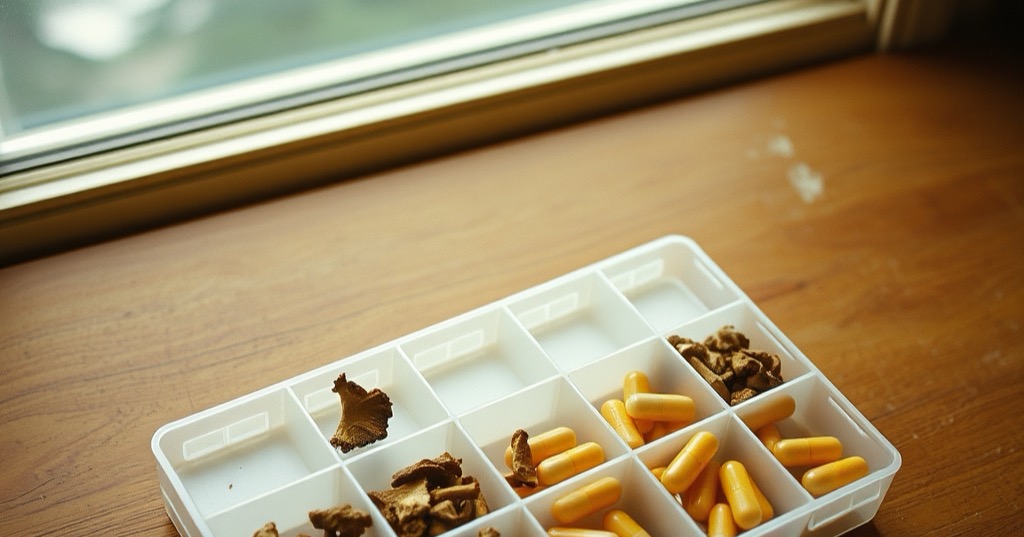
Microdosing, taking sub-perceptual amounts of psilocybin or LSD on a regular schedule, has gone from fringe to dinner-table normal. People credit it with lifting depression, sharpening focus, and smoothing anxiety. The personal testimonials are vivid and sincere. So here's the uncomfortable question worth sitting with: when researchers design studies that can actually tell the difference between a drug effect and a hopeful expectation, what do they find?
The short answer: a lot less than the enthusiasm would suggest. And the reason why is genuinely interesting.
The placebo problem isn't a footnote, it's the whole story
Almost all the glowing reports about microdosing come from surveys and observational studies, where people who already believe in microdosing report how they feel. That design can't separate the molecule from the mindset. To do that, you need a placebo control and blinding, where neither the participant nor the researcher knows who got the real thing.
When scientists build that in, the effects tend to evaporate. A review in Biological Psychiatry: Cognitive Neuroscience and Neuroimaging surveyed the controlled studies and concluded that, despite the anecdotes, rigorously controlled trials have largely failed to produce compelling evidence that microdosing improves mood, cognition, or creativity beyond placebo.
The cleverest study let people blind themselves
The most striking evidence comes from an eLife study by Szigeti and colleagues, the largest placebo-controlled psychedelic study of its kind, with 191 participants who microdosed in real life. Using an ingenious "self-blinding" protocol, people followed instructions to mix real microdoses and placebos into identical capsules so they couldn't tell which was which on any given day.
The result: people who believed they had taken a real dose reported greater well-being and lower anxiety, regardless of whether they had actually swallowed psilocybin or a placebo. Belief, not the drug, tracked the benefit. As the authors framed it, the perceived gains of microdosing may be driven substantially by expectation.
A separate double-blind, placebo-controlled study of 34 people who took 0.5 grams of dried mushrooms reinforced the point from a different angle. Participants correctly guessed whether they'd had the real dose about three-quarters of the time, and once the researchers separated out those who'd unintentionally broken the blind, the apparent benefits disappeared. Their conclusion was blunt: low doses produced noticeable subjective effects "but without evidence to support enhanced well-being, creativity and cognitive function."
So is the placebo effect "nothing"?
No, and this is where honesty cuts both ways. If a daily ritual reliably makes you feel calmer and more hopeful, that improvement is real to you, even if its engine is expectation rather than pharmacology. But two things follow. First, you can often get a placebo-driven lift from rituals that don't involve an unregulated, variable-potency substance. Second, and more importantly, "it's mostly placebo" means the practice hasn't earned the status of a treatment, and shouldn't be relied on in place of care that has been tested.
Why the testimonials are so persuasive anyway
If the controlled data is so thin, why does microdosing feel so convincing to so many people? A few forces stack up. There's the expectancy effect itself, the same mechanism the self-blinding study isolated. There's the natural ebb and flow of mood, where people often start a new regimen when they're at a low point and would have rebounded anyway. There's the deliberate ritual of pausing each morning to take something "for your mind," which is itself a small act of self-care. And there's selection in what gets shared: people who feel great post about it; people who felt nothing quietly stop. Stack those together and you get a powerful collective impression that rigorous trials simply don't reproduce.
What we don't yet know, and a few real risks
It's fair to say the science is early, not closed. Microdosing studies are short, doses and substances vary, and most look at healthy volunteers rather than people with diagnosed conditions. Larger and longer trials are underway, including placebo-controlled work testing microdosing specifically for major depression. It's possible that better-designed studies will find narrow, real benefits in particular domains. Promising and unproven are not the same as debunked, and intellectual honesty cuts against overclaiming in either direction.
At the same time, microdosing isn't risk-free. Mushroom potency in the unregulated market is inconsistent, so the "micro" in your dose is genuinely a guess from batch to batch. Frequent dosing in people with cardiac concerns warrants caution, and anyone with a personal or family history of psychosis should be especially careful with any psychedelic, even at low doses. It's also worth being clear that microdosing sits entirely outside Oregon's regulated psilocybin program: that program involves a single supervised, higher-dose session at a licensed center, not a take-home daily regimen, so none of its safety oversight applies to a microdosing routine you manage on your own.
The contrast with what's actually been established
It's worth noting how different this picture is from the better-tested end of psychedelic medicine. NIMH-led research found that a single intravenous dose of ketamine produced significant antidepressant effects in about 71% of people with treatment-resistant depression, with remission in about 29%, work that helped lead to the FDA's 2019 approval of esketamine (Spravato) for treatment-resistant depression. That's what a strong, supervised, well-controlled evidence base looks like. Microdosing, by contrast, is still mostly a hypothesis with passionate fans.
The honest 2026 position: microdosing is fascinating, widely practiced, and not yet supported by the controlled science, with the placebo effect doing most of the visible work.
If you're microdosing to manage depression or anxiety, the most evidence-based move is to pair curiosity with care that's actually been tested. You can find an Oregon provider to talk through options that don't depend on hope alone.


