Related Podcast: Inked Therapist Podcast Episode 11
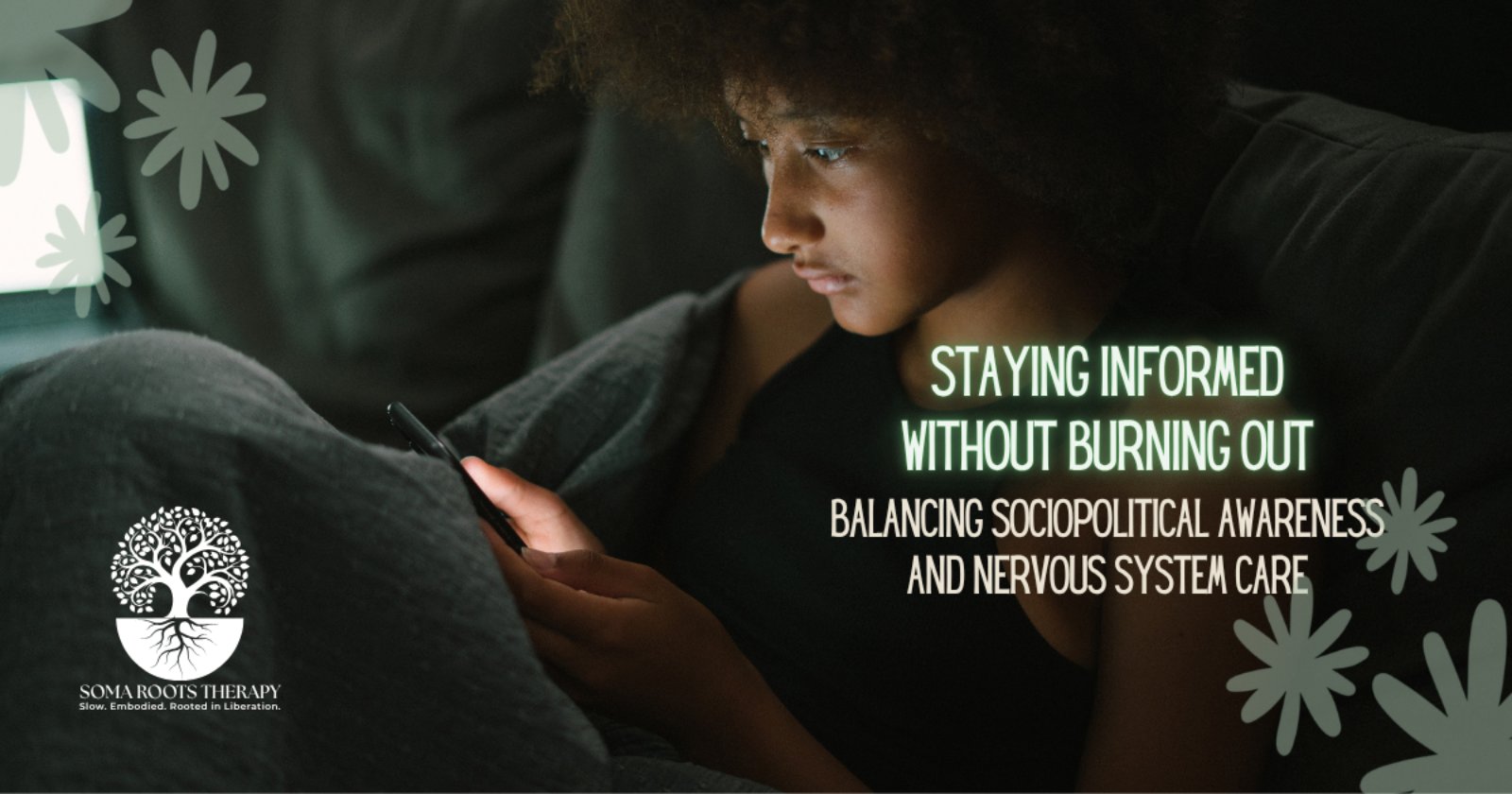
Staying sociopolitically informed matters—especially when your communities are directly impacted by injustice—but so does having a nervous system that isn’t permanently stuck in fight, flight, or freeze. Chronic exposure to violent news and online discourse can activate the body as if the threat is in the room, leading to ongoing stress, anxiety, and vicarious trauma. Balancing both isn’t about apathy; it’s about designing sustainable, values-aligned engagement that doesn’t sacrifice your health or capacity to act.
Why Your Nervous System Can’t “Scroll It All”
Research on news overload shows that constant exposure to distressing content—especially graphic images and rolling coverage—activates the sympathetic nervous system, increasing stress hormones like cortisol and adrenaline. Over time, this can impair memory, focus, and emotional regulation, and contribute to burnout, sleep issues, and a sense of hopelessness. This is especially acute for folks already living with trauma, marginalization, or chronic stress, whose baseline activation is often higher before they even open the news.
Feeling overwhelmed by the news is not a sign that you don’t care; it’s a sign that your body is working as designed in a context that was not designed for your wellbeing. When endless scroll becomes your main portal to the world, your nervous system ends up drafted into “unending output,” constantly mobilized without enough chances to rest and repair.
Honoring BIPOC Lineages of Rest, Care, and Resistance
Conversations about balancing activism, information, and rest build on long-standing work from Black, Indigenous, and other scholars and organizers of color who name self- and community-care as tools for survival and social justice. Black feminists and thinkers like Tricia Hersey of The Nap Ministry have framed rest as resistance, connecting grind culture, white supremacy, and the theft of Black labor to modern exhaustion. Others highlight that rest and restorative practices are not about checking out, but about sustaining movements and refusing to let systems turn bodies into tools of endless production.
BIPOC writers also describe “trauma organizing,” where individuals and movements become unconsciously organized around chronic stress and unresolved trauma—making nervous system regulation a collective political issue, not just a personal wellness project. Crediting these lineages matters; it reminds us that sustainable engagement and nervous system care are part of liberation work, not a distraction from it.
Designing Boundaries Around News and Social Media
Evidence-based suggestions for staying informed without overload include limiting sources, setting time boundaries, and curating what you consume, rather than letting algorithms decide for you. Some helpful shifts:
-
Fewer, trusted sources: Choose a small number of reputable outlets or newsletters instead of constant breaking updates and endless feeds, which reduces cognitive overload and repeated exposure to the same distressing imagery.
-
Time and place limits: Set specific windows for checking news (e.g., once or twice a day) and avoid doom-scrolling late at night, when your nervous system is trying to downshift into rest.
-
Content filters and formats: Favor text summaries or digest-style formats over autoplay videos and graphic footage, which are more likely to trigger intense physiological responses.
None of this means disengaging from reality; it means treating your attention as a finite resource that deserves stewardship, especially if you’re already living inside the issues on your screen.
Practices for Nervous System Regulation While Staying Engaged
Somatic approaches can help your body move between states of activation and rest, rather than getting stuck on “on.” A few accessible practices:
-
Before you open the news: Take a slow breath, feel your feet, or orient to the room by noticing a few objects; this gives your body a reference point for safety before exposure.
-
During consumption: Notice early signs of overload—shallow breathing, clenching, numbness, compulsive refreshing—and use micro-pauses, movement, or a drink of water to reset.
-
After a hard story: Shake out your hands, step outside, or briefly stretch; research and clinical practice in somatic work suggest that gentle movement can help metabolize some of the activation held in muscles and fascia.
For people in targeted communities, it’s also important to name that “regulation” doesn’t mean becoming calm in the face of injustice; it means having enough flexibility to feel, act, rest, and connect without getting swallowed by constant hyperarousal or collapse.
Choosing the Scale and Shape of Your Engagement
Despair is more likely when your news consumption is dominated by large-scale crises where your individual impact feels negligible. Shifting part of your attention to local issues, mutual aid, or concrete campaigns can reduce helplessness and support a sense of agency. Studies and reporting suggest that constructive or solutions-focused journalism—highlighting responses and possibilities, not just problems—can also buffer some of the impact of the news.
You might experiment with questions like:
-
“What are the 1–2 issues I will follow closely right now?”
-
“Where do I actually have leverage or connection?”
-
“What forms of action (money, time, art, care work, organizing) are sustainable for my body?”
Seen this way, nervous system regulation is not separate from sociopolitical engagement; it is part of how you protect your capacity to show up over the long haul.
How Soma Roots Therapy Holds This Tension
At Soma Roots Therapy, sociopolitical context is not background noise; it’s acknowledged as part of why many nervous systems are stretched thin. Sessions might include exploring how news cycles, identity-based trauma, and systemic violence land in your body, alongside building personalized practices for boundaries, rest, and solidarity that feel honest rather than performative.
The work is not about choosing between “staying informed” and “staying regulated,” but about weaving them together in a way that honors your nervous system, your communities, and your values. You deserve to be awake to the world without sacrificing your health to it—and your body’s need for pacing, pause, and pleasure is not a betrayal of the struggle, but part of sustaining it.
Want to learn more?: Listen to the associated Inked Therapist Podcast Episode 11


